
Have you ever thought about purchasing a surround sound system or wanted to upgrade your existing system, but weren't sure where to start?
Surround sound delivers a more realistic and entertaining experience whether you are watching action movies, sports, horror flicks, or even children's movies because quality audio puts you in the middle of the action.
Designing a home theater audio system can appear to be overwhelming but it doesn't have to be. Simply answer these questions for yourself and you can simplify your choices to a manageable list of product options.
Do I Want a 3.1, 5.1, or 7.1 Speaker Configuration?
Most flat screen TVs do not have adequate audio capabilities due to their thin depth — they simply don't have the room to install a quality speaker into the frame of the TV. It's easy to improve the sound with external speaker options, but first you need to decide whether you want a 3.1, 5.1, 7.1, or other configuration. There are even more options you could opt for, but if you are new to home theater, these are the most common. The ".1" in these configurations refers to the subwoofer.
3.1 Speaker System
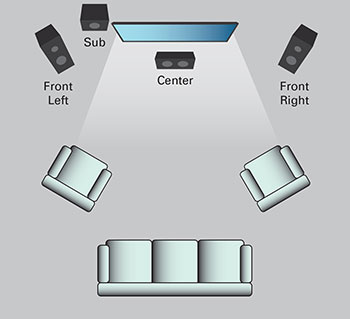
A 3.1 system is the easiest on your bank account. It consists of Front Left (FL), Front Right (FR), and Center Channel (C) speakers as well as a subwoofer. This type of system will be a significant improvement over the audio your TV can provide. The center channel should be placed at ear level when sitting in front of the TV — typically under or over the TV. The Front Right and Front Left speakers go to the left and right of the TV and are pointed toward the viewing area. The subwoofer works best when it is placed in a corner where the low frequencies can "load" off the corner and create the rumbling effects of thunder, airplanes flying overhead, explosions, etc. The center channel is where the majority of the vocals from the characters speaking comes from.
5.1 Speaker System
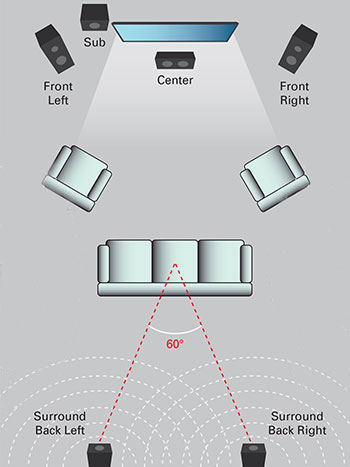
A 5.1 system is a 3.1 system with the addition of Right Rear and Left Rear speakers. These additional speakers play footsteps sneaking up behind you, screams coming from a back room, and explosions going off in the distance. The addition of the rear channels puts you in the center of the action movie, sports game, or horror film and adds a whole new dimension to the audio. You can actually hear airplanes flying overhead as they start in the front of the room and transition to the back. The main character in a thriller can be looking behind the camera in fear while she is crying — the sound of her crying will be played through the center channel and front right and left speakers while the sound of the villain chasing her down will come from the rear left and right channels.
7.1 Speaker System
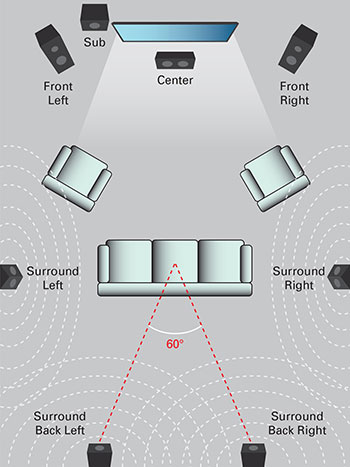
A 7.1 system is a 5.1 system with the addition of Middle Right (MR) and Middle Left (ML) speakers. This system includes all of the benefits of a 5.1 system with an extra pair of speakers to help with transitioning audio from front to back. As a bullet passes through the air, a viewer can hear the bullet fire from the front and center channels, pass through the air through the middle right and left channels, and then hit its target in the rear right and left channels. A fighter plane in a dog fight may shoot a missile that misses its target and you will hear the missile pass through your living room.
In each of these systems, you will also need an appropriate home theater receiver/amplifier. If you choose a 7.1 system, you will need a receiver that is equipped to process 7.1 surround sound. A 5.1 receiver with a 7.1 speaker configuration will not utilize the Middle Left and Right speakers. A 7.1 receiver will work with a 3.1 or 5.1 speaker configuration but the audio it is trying to send to the Middle Left and Right speakers will not have speakers to reproduce it.
Once you have decided the type of speaker configuration you want, you can start selecting the type of speakers you want.
What Type of Speaker Do I Want?
There are a variety of speaker options to choose from — floor standing cabinet speakers, custom in-wall and in-ceiling speakers, wireless speakers, surface mount speakers, and more. The choice depends on what you want your system to look like.
Cabinet Speakers
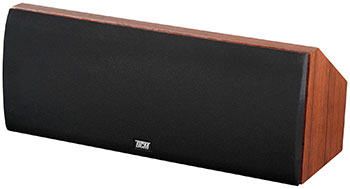
Cabinet speakers can generally produce better sound than custom in-wall/in-ceiling speakers and wireless speakers. Surface mount speakers are also considered cabinet speakers but they are intended to be mounted to the wall instead of sitting on the floor.
Built-In Speakers
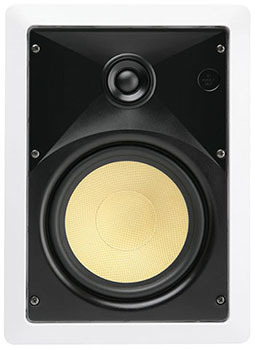
Custom in-ceiling/in-wall speakers do not take up any space on your floor and can blend right into the wall without being noticeable. Custom in-wall/in-ceiling installations can result in a bit more work because you have to cut a hole in the drywall and run cables through your walls, but can generally be handled by an experienced DIYer. New construction makes this option more attractive. The finished product is a very smooth, finished look. The speaker grilles are paintable so you can color match them to any wall color.
Wireless Speakers
Wireless speaker options are a great solution for applications where running wires isn't possible. Wireless speakers still need to be plugged into an outlet for power, but they receive the audio signal wirelessly, eliminating the need for speaker wire runs. While wireless audio signals continue to improve as technology evolves, most would agree that wired signals still have an edge in audio quality. Wireless audio products are a solution to installation challenges and are also a great option for apartments or rentals where you may not be able to cut holes in the walls.
Some systems will be a combination of all of these product types. For example, a person may use cabinet speakers for Front Left and Right and the Center Channel, surface mount speakers for Middle Left and Right, and custom in-ceiling speakers for Rear Right and Left. Others may use custom in-wall/in-ceiling speakers for the entire system — there are even in-wall/in-ceiling subwoofers available so that nothing is sitting on the floor or sticking out from the wall.
Home Theater Speaker Packages
Once you have identified the speaker configuration and type you want, you've done most of the work. Now just select your speakers based on your budget, size, and desired finish (wood grain, black, white, etc.) and you'll have a movie theater in your living room before you know it.
Frequently Asked Questions
Our team can help you put together a complete system for your room size and budget. Reach out and we'll get you sorted.
Contact us Find a dealer