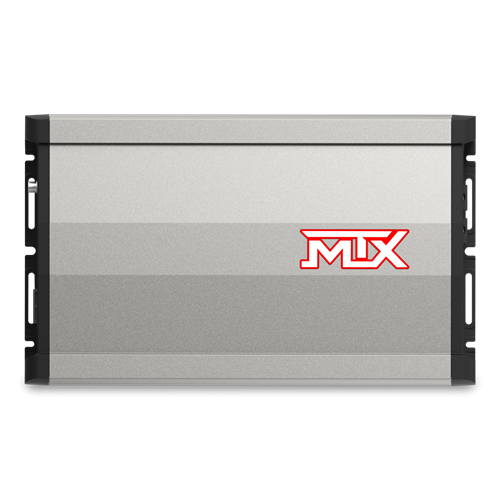
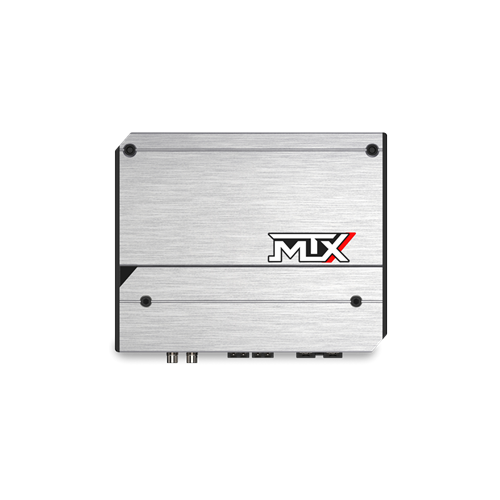
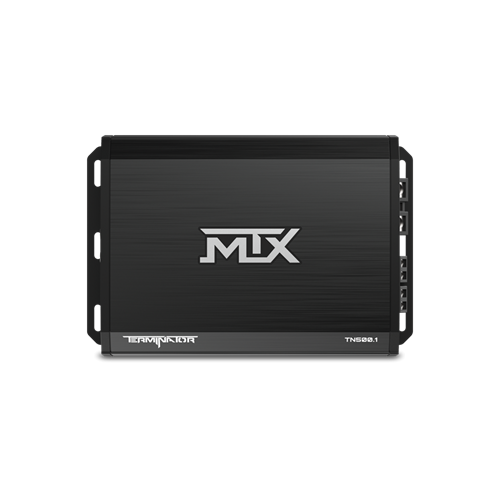
No matter what you listen to or how loud you like it, your car audio system will perform better with a dedicated amplifier. Factory head units are built to fit in a dashboard, not to deliver clean, powerful audio. An external amp changes that.
Three Reasons to Add an Amplifier
Reason 01
Better Sound Quality
An external amplifier does a much better job of providing a clean audio signal than your head unit. A dedicated amp reproduces the audio signal as it was recorded at all volume levels, handles transients like cymbal crashes without clipping, and doesn't sacrifice quality due to the space limitations of factory radios and head units.
Reason 02
Power for Upgraded Speakers
When you replace factory speakers with higher quality aftermarket speakers or component systems, an amplifier provides the correct power for optimized performance. Without an amplifier, the head unit is the bottleneck — and better speakers can only sound as good as the signal feeding them.
Reason 03
Powering a Subwoofer
Subwoofers require far more power than the typical speakers in a vehicle. A dedicated amplifier channel is required when adding a subwoofer to any audio system.
Should You Amplify Factory Speakers?
Generally no
In most cases you do not want to add an amplifier to factory speakers. Manufacturers select those speakers for specific reasons and they may have low impedance voice coils or other characteristics that make them incompatible with aftermarket amplifiers. If you want your factory sound system to be louder or sound better, replace the speakers first, then add an amplifier.
Amplifying Upgraded Aftermarket Speakers
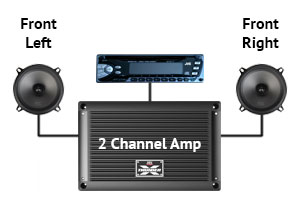
Two-channel amplifier layout — one channel per speaker
Upgrading your speakers and adding an amplifier is the best way to improve sound in your vehicle. A system like this typically includes a four-channel amplifier and the appropriate size speakers to replace factory units. By combining higher-performance aftermarket speakers with a clean amplifier signal, you will vastly improve the sound while keeping the interior looking stock.
When matching an amplifier to speakers, pair the amp's RMS output to the speakers' RMS power handling rating. If your front and rear speakers have slightly different ratings, use the lower rating as your guide. It is generally more harmful to underpower speakers than to provide slightly more power than the rating. Always use RMS ratings — terms like Peak Power and Max Power do not reflect real-world performance.
Four-channel amplifiers have independent gain settings for the front and rear stages, letting you balance the output to your preference. The head unit's fade control adds another layer of front-to-back adjustment. The MTX TH400.4 is a strong 4-channel choice for a full speaker upgrade.
Four-channel amplifiers are also versatile in other configurations. For example, two channels can be bridged to power a subwoofer while the other two power a pair of speakers. There are also five-channel amplifiers like the MTX Terminator TN800.5 that power your entire system from a single compact unit — four channels for speakers and one higher-powered channel for the subwoofer. For more complex builds, MTX also offers a 6-channel amplifier that adds a sixth channel for a second subwoofer or additional speaker.
Amplifying Subwoofers
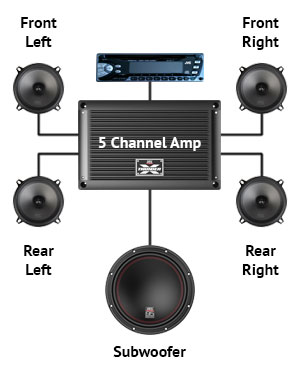
Five-channel amplifier layout — four speaker channels plus one subwoofer channel
Monoblock (single-channel) amplifiers are designed specifically to power subwoofers and work across a wide range of impedances. They include tone controls and filters built for low-frequency bass reproduction. While 2 and 4-channel amps can be bridged to increase power enough to run a sub, they are less efficient in this mode and are typically limited to 4-ohm bridged operation, which limits your subwoofer wiring options.
Make sure your amplifier is stable at the impedance your subwoofer is wired to and can produce power that closely matches the subwoofer's RMS rating. For example, two 12" single 4-ohm voice coil subwoofers could be wired to a final impedance of 2 ohms or 8 ohms depending on series or parallel wiring.
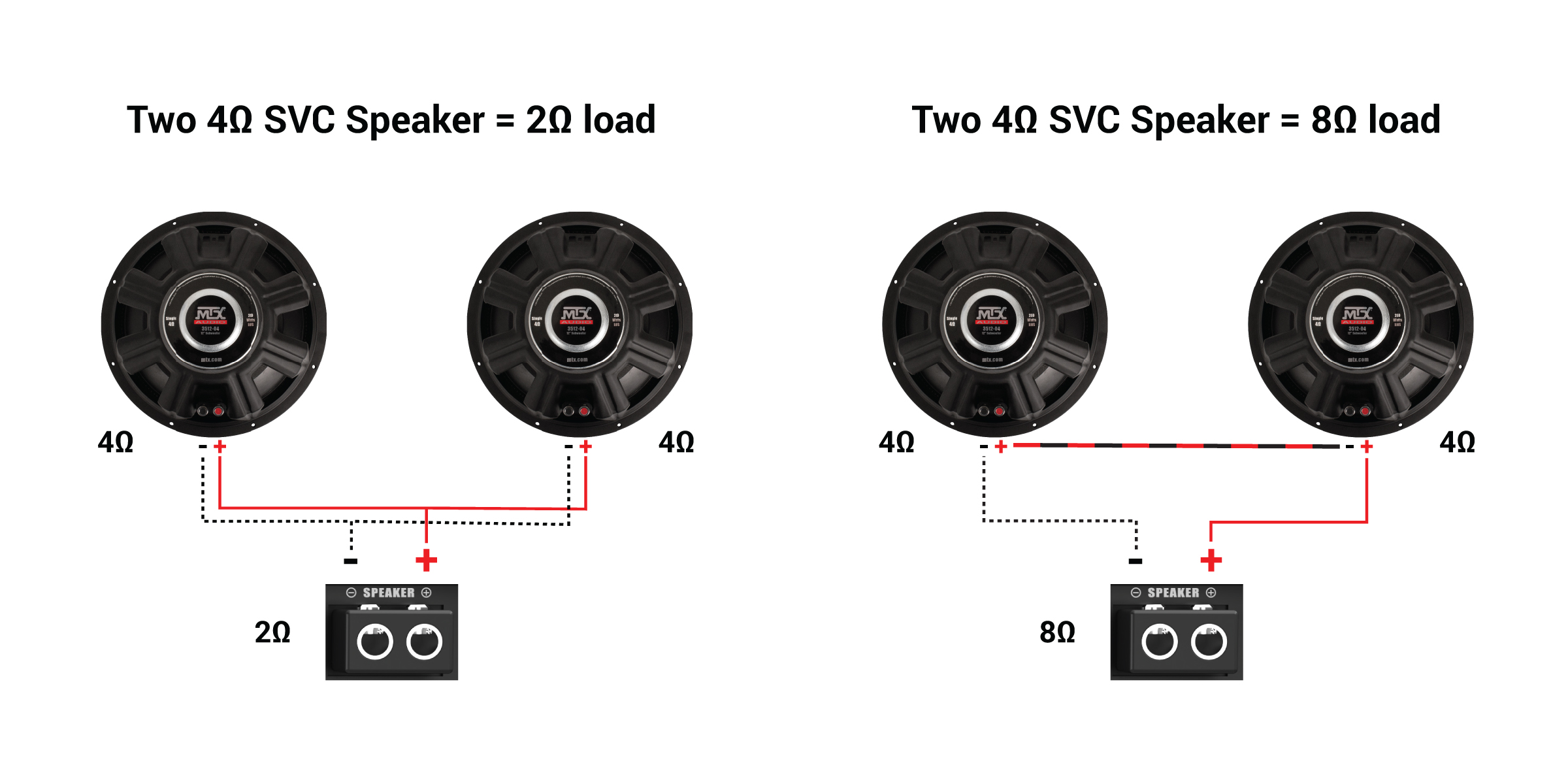
Two single 4-ohm voice coil subwoofers — parallel (2Ω) or series (8Ω) wiring options
Adding a sub to a factory system
If you are connecting a subwoofer amplifier to a factory head unit, you will need an amp with speaker-level (high-level) inputs, or a high-to-low converter, since factory head units do not have RCA outputs.
Choosing the Right Amplifier Type
Monoblock
Single channel. Designed for subwoofers. High power, wide impedance range, bass-specific filters. Best choice for any dedicated sub application.
4-Channel
Powers four speakers or can be configured to run two speakers and a subwoofer (two channels bridged). Versatile for full speaker upgrades.
5-Channel
Powers a full system from one unit. Four channels for speakers plus one higher-powered channel for a subwoofer. Clean install, single amplifier.
6-Channel
Full system plus more. Four channels for speakers, one for a subwoofer, and a sixth channel for a second sub or additional speaker. Ideal for more complex builds.
Amplifier Wiring Kits
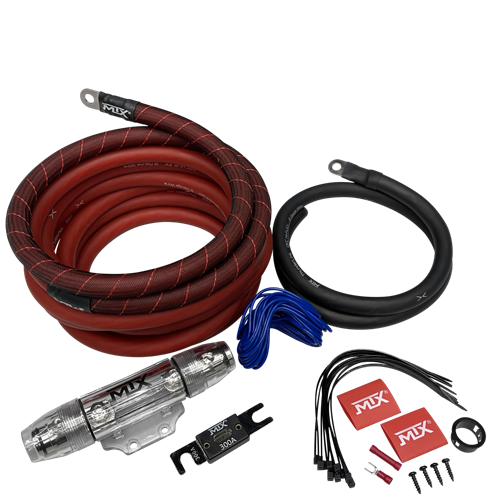
Amplifiers don't include everything needed to install them. You will need to wire the amplifier's positive input to your vehicle battery, find a chassis ground for the negative, connect it to the head unit via RCA cables, and run a remote turn-on wire. Amplifier wiring kits include power wire, ground wire, speaker wire, remote turn-on wire, fuse, fuse holder, and battery terminals. MTX ThunderLink wiring kits have everything needed to make installation straightforward.
Frequently Asked Questions
Why do I need an amplifier for my car audio system?
Your head unit produces a weak signal that cannot drive upgraded speakers or subwoofers to their potential. A dedicated amplifier provides clean, sufficient power at all volume levels, handles transients without clipping, and is essential when adding a subwoofer which requires far more power than any factory head unit can provide.
Should I add an amplifier to my factory speakers?
Generally no. Factory speakers often have characteristics like low impedance voice coils that make them incompatible with aftermarket amplifiers. If you want better sound, replace the factory speakers with aftermarket ones first, then add an amplifier.
What type of amplifier do I need for a subwoofer?
A monoblock (single channel) amplifier is the best choice for subwoofers. They are designed for low frequencies, work across a wide impedance range, and include bass-specific tone controls. While 4-channel amps can be bridged to power a sub, they are less efficient in this configuration and typically limited to 4-ohm bridged operation.
Is it worse to underpower or overpower speakers?
Underpowering is often worse. An underpowered amplifier is more likely to clip, sending a distorted signal that generates excess heat in the voice coil. Most speakers can handle slightly more power than their rated RMS — what damages them is clipping from an amp that is too small and being driven past its clean output range.
Do I need a wiring kit to install an amplifier?
Yes. Amplifiers do not include installation wiring. You will need at minimum: power wire (from battery), ground wire (to chassis), RCA interconnects (from head unit), remote turn-on wire (from head unit), an inline fuse near the battery, and speaker wire to the speakers or subwoofer. Amplifier wiring kits include all of these in matched gauges for a clean install.